
Rembrandt. A Portrait of Human Existence.
Larysa Sidak
Fifty prints from the collection of the Rembrandt House Museum are currently on display in an exhibition entitled Rembrandt & Life. But I would like to begin not with the exhibition itself.
The Rembrandt House in Amsterdam is an extraordinary place. Not simply because it is a museum dedicated to an artist, but because it is a museum dedicated to a man who wanted a great deal from life and, in return, gave a great deal of himself to it. The Rembrandt House is experienced not as a monument to genius, but as a testament to ambition. It was here that Rembrandt settled in 1639 — young, celebrated, and prosperous enough to purchase one of the finest houses in the city. Perhaps he believed then that fortune had signed a lifelong contract with him. Yet fortune, as we know, has always loved drama no less than it loves art. It was within these walls that Rembrandt created many of his most famous works. Here he taught pupils, dealt in art, argued passionately, fell in love, lost those closest to him, and gradually descended into financial ruin. Remarkably, it is from the inventory drawn up during his bankruptcy proceedings that the house has been reconstructed today with almost archaeological precision.

Self-Portrait, Leaning on a Stone still, 1639
Etching and drypoint, state 2(2), 205 x 164 mm
What is most moving about this place is its lack of grandeur — or rather, its lack of ostentatious grandeur. A narrow bed. Steep staircases. A collection of shells, butterflies, minerals, and other curiosities with which Rembrandt surrounded himself, like a child for whom the world remained an endless source of wonder. And, of course, the studio, flooded with northern light. At a certain moment, a simple realization becomes unavoidable: great paintings were not created in a temple of art; they were created at home. And perhaps this is the most Dutch lesson of all. Amsterdam has little taste for grand gestures. Its canals whisper where other capitals speak at full volume. The Rembrandt House is much the same. It does not seek to impress its visitors. Instead, it invites them in. Nowhere does it become clearer that Rembrandt was not merely a painter of light. He was also a painter of human destiny. After all, his own life unfolded like a novel: success, love, wealth, fame, debt, loss, and an unwavering determination to continue painting despite every hardship that befell him.
The Rembrandt House Museum is a place where we do not encounter Rembrandt himself, yet nowhere is his presence more palpable. Something of his spirit still seems to inhabit these rooms. Here, one meets not the creator of The Night Watch, nor the bronze genius of art history textbooks, but Rembrandt the man. Perhaps that is why, among Amsterdam’s many museums, this house remains one of the few from which visitors emerge with the feeling that its owner has merely stepped out for a moment and may return at any time.
It is fitting that Rembrandt’s printing press stands on the top floor of the house, in a room that feels closer to the sky than any other. The space has the atmosphere of a sanctuary — a place where the artist engaged directly with the world, capturing image after image with nothing more than an etching needle and a copper plate.
It is precisely Rembrandt’s virtuosity as a printmaker that the exhibition Rembrandt & Life seeks to illuminate.
The art of etching — whether through the use of the etching needle or the process of acid biting — follows its own exacting rules. To master it requires far more than the ability to draw well or compose an image effectively. It demands a steady hand, for a line cut into the plate can rarely be corrected; intense concentration; meticulous attention to detail; and a deep understanding of the physical and chemical processes that underlie printmaking itself. Rembrandt mastered this medium with extraordinary skill. More than that, printmaking became one of his most important ways of engaging with the world on a daily basis. Through it, he observed, interpreted, and recorded the life unfolding around him.
The essence of the process lay in drawing directly onto a carefully polished copper plate with an etching needle. Oil-based printing ink was then worked into the engraved lines, and the plate was run through a printing press together with a sheet of paper. Under the pressure of the press, the paper drew the ink from the grooves, giving rise to an image of extraordinary subtlety and expressive richness. A single plate could yield dozens of impressions. Over time, however, the delicate lines gradually wore down, and the quality of the print diminished. Plates were therefore often polished and reused for new works.
In Rembrandt’s time, etching was the most accessible means of reproducing a human likeness long before the invention of photography. No other medium allowed an image to be multiplied in such numbers. Unlike a painting or a drawing, a print could be produced repeatedly from the same plate, making it available to a much wider audience. It is therefore reasonable to assume that Rembrandt accepted commissions for portrait etchings. Yet printmaking was far more to him than a craft or a source of income. It became an independent artistic language through which he could explore and express his most personal ideas.
The exhibition Rembrandt & Lifeis structured around the principal stages of human existence. Before the viewer pass children, adults, and the elderly — the three ages of life to which the artist returned throughout his career. A separate section is devoted to the moment of transition: biblical subjects that contemplate the boundary between earthly existence and whatever may lie beyond it.
The exhibition offers a rare opportunity to view original works by the artist and to observe how the character of his line changes according to subject matter, mood, and emotional intent. The expressive quality of line in Rembrandt’s etchings reveals not only a brilliant draftsman and master printmaker, but also a subtle psychologist. Working with little more than line, tone, and chiaroscuro, he creates images that differ profoundly in atmosphere and emotional resonance. For each sitter, he develops a distinct graphic language capable of conveying the individual character of the person portrayed. This becomes apparent from the very first works in the exhibition.

Portrait of a Boy in Profile, 1641, Etching, state 2(2), 93 x 67 mm
In Portrait of a Boy in Profile (1641), soft, flowing lines predominate. They are particularly evident in the rendering of the boy’s hair, conveying a sense of lightness and vitality. The same delicate handling appears in the lace collar and in the folds of the voluminous sleeves, allowing the viewer to almost feel the texture of the fabric. The face is constructed through a denser and more refined network of lines, yet even here the lines gently follow the contours of the form. At the same time, Rembrandt avoids the conventional emphasis on an illuminated face that was common in portraiture of the period. Instead, the boy appears turned away from the light source and immersed in half-shadow. There is little trace of youthful carefree joy in his expression. Rather, he conveys a sense of inward concentration, contemplation, or even a quiet melancholy. Perhaps this is why the light seems to remain symbolically somewhere behind him — as if waiting for a change in the weather of the soul.

Portrait of Samuel Menasseh ben Israel 1636, Etching, state 3(5), 149 x 103 mm
A very different impression is created by Portrait of Samuel Menasseh ben Israel (1636). Here we encounter a mature and accomplished man. To shape this image, Rembrandt employs longer, more assured lines. Particular attention is devoted to the sitter’s hat, whose density and material presence are rendered through an intricate network of cross-hatching. The light is orchestrated in such a way that the face and upper body seem to be singled out by a concentrated beam. One has the impression that the sitter is seated beside a window, beyond which passing clouds alternately reveal and obscure the sun. The portrait conveys dignity, intellectual strength, and a profound sense of self-possession. Yet the sitter’s gaze remains open to interpretation. There is a hint of detachment and contemplation in his expression, lending the image a remarkable psychological complexity and vitality.

Christ Before Pilate, 1635, Etching, state 4(5), 549 x 447 mm
The expressive potential of Rembrandt’s graphic language emerges even more powerfully in the multi-figure composition Christ Before Pilate (1635). Here the artist constructs the pictorial space through a unified system of cross-hatching that binds the numerous figures into a single dramatic whole. The characters in the foreground are rendered with extraordinary care, while the masterful use of light and shadow immediately guides the viewer toward the compositional and emotional centre of the scene. Yet the true source of the work’s emotional tension lies not only among the figures themselves. One need only look at the sky in the upper left corner of the sheet. Here Rembrandt employs long, energetic lines that differ strikingly from the calmer treatment of the rest of the composition. These forceful lines generate a sense of unease and impending catastrophe. It is as though the tragedy first takes shape in the heavens before gradually descending upon the crowd below, filling the scene with mounting psychological intensity. Through this device, the biblical narrative ceases to function merely as a historical episode. Instead, it becomes a lived experience — one that the viewer feels almost physically.

Old Man Looking Down, 1631, Etching and burin, state 2(3), 119 x 117 mm
Old Man with a Flowing Beard, 1630, Etching, state 1(2), 98 x 81 mm
Old Man, 1630, Etching, state 2(3), 68 x 46 mm
In the section of the exhibition devoted to old age, etchings are presented with an even more intricate and refined graphic language. Elderly figures undoubtedly attracted Rembrandt through their expressive appearance, the richness of their surface detail, and the inherent drama of human fate. Yet something else is striking: in his depictions of old age, the artist once again returns to a softer line. Moreover, the individual lines become shorter, as if hinting at the nearness of life’s completion. They flicker, dissolve, and gradually fade away. Dark areas in the composition are perceived as a shadow slowly consuming the light, even though the illuminated passages still occupy a significant portion of the sheet.
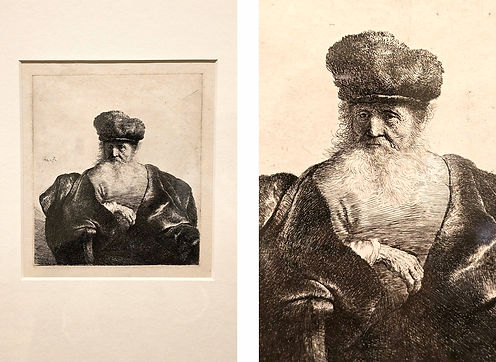
Old Man with a Fur Cap and Velvet Cloak, 1631, Etching and burin, state 2(3), 149 x 130 mm
A very different solution is found in the etching Old Man(1631). Here we encounter an older man who nevertheless appears to have retained a high social standing and an inner sense of dignity. Rembrandt renders the richness of his attire with remarkable precision. The fur cap, heavy cloak, and complex textures of the fabrics occupy a substantial part of the composition and become a key expressive element of the image. It almost feels as though clothing itself carries a particular semantic weight here. The darkness that in earlier works existed only as a suggestion of shadow now acquires a tangible form. It becomes, as it were, the burden of a life lived — the weight of experience, achievement, duty, and memory. The contrast between the dense dark silhouette and the face, softly modelled through short, undulating lines, further intensifies the internal tension of the image. We are left with a figure standing on the threshold of eternity, yet still firmly bound to the earthly world.
It is remarkable how varied Rembrandt is in his graphic interpretation of human character. In this exhibition, it is impossible to find two portraits constructed according to the same artistic principle. Any sense of formulaic repetition is entirely alien to his art. Each image emerges from careful observation and from an intense inner dialogue between the artist and the person depicted. Every work contains an attempt to understand the other — their character, their state of mind, their life path. For this reason, Rembrandt’s etchings speak not only about those who are portrayed, but also about the artist himself.
When we look at his prints almost four centuries later, we perceive not only the scale of his mastery. We grasp something far more essential: the living curiosity with which he observed people, the attentiveness with which he followed the unfolding of human life, and the subtlety with which he sensed its key stages — childhood, maturity, and old age. His figures belong to the seventeenth century, yet their anxieties, hopes, dignity, loneliness, and desire to be understood remain strikingly contemporary.
This is perhaps the central secret of Rembrandt. He did not depict an era, a costume, or even an individual person. He depicted human life itself. And that is why his works continue to speak to us as though they had been created only yesterday
Author of the article: Larysa Sidak,
June 12, 2026.


NEWS
Exploring Art & Culture
of the Netherlands


