
KUNSTPROJECT
In het licht van Vermeer
Boundless love for art: William and Anna Singer
Diana Kostman
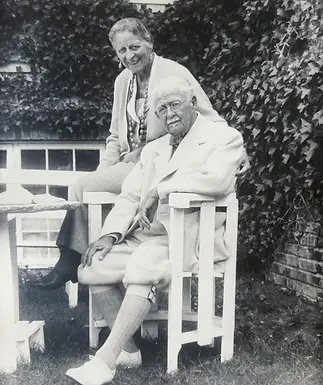
On June 26, 1895, the Americans William Henry Singer Jr. and Anna Spencer Brugh were married. William was the wealthy son of a steel magnate, yet he was far more interested in art than in business. When his father sold the company in 1900, it granted William financial independence and allowed him to devote himself entirely to both painting and collecting art. The Singers would remain childless, but shortly before William’s death, Anna wrote in her diary in 1942:
“Your Art was our child, beloved by me from the moment we together gave it its chance to grow and mature.”¹
Like many American artists, William and Anna moved to Europe, initially settling in the art capital of Paris. There, in the autumn of 1901, William enrolled at the independent and progressive Académie Julian, an institution popular among modern-minded artists and attended by international students.
The following spring, the Singers decided to spend the summer in the picturesque village of Laren. At first glance, this seems a remarkable choice, as most Paris-based artists preferred to spend their summers in Normandy, following in the footsteps of the most famous Impressionist, Claude Monet. However, William had a deep admiration for Dutch artists of the Hague School and was particularly fond of Mauve’s paintings of sheep — a preference also reflected in the sheep sketches he produced during this period. Moreover, artists from Laren were immensely popular in the United States, making the village a logical choice for a summer stay.
William and Anna had originally intended to remain in Laren only for the summer months of 1902. They chose to stay at the heart of Laren’s artistic community: the by-then fashionable Hotel Hamdorff. What began as a planned three-month stay ultimately turned into many years (interspersed with periods spent in, among other places, the United States, Norway, and Paris). During these years, the Singers formed friendships with numerous artists, whose works they also began to collect. The core collection of today’s Singer Museum was established through purchases of works by artists such as Albert Neuhuys, Hein Kever, and Evert Pieters. In 1903, the Singers left the hotel for a house with a studio on Oude Naarderweg, later followed in 1911 by the construction of the villa De Wilde Zwanen on Oude Drift — now known as Singer Laren.
Although it had initially been Mauve’s sheep that attracted William, he found the Dutch landscape too flat and subdued for his taste. His true inspiration would come from the overwhelming landscapes of Norway. Upon encountering Norwegian art, he is said to have exclaimed: “Anna, I have found my country.”² From 1903 onward, the Singers spent much of their time in Norway, where they also owned a home.
In the Netherlands, however, they remained inextricably linked to Laren, a place to which they would return time and again. This bond was further strengthened after William’s death in 1943, when Anna sought a way to commemorate her husband permanently. This ultimately led to the establishment of the Singer Memorial Foundation. In 1956, a museum combined with a concert hall opened in Villa De Wilde Zwanen — a unique fusion of visual and performing arts. To this day, both William and Anna are remembered for their artistic legacy, a cultural heritage that continues to grow, as evidenced by the recent major renovation of the Singer and the planned expansion in the form of the Nardinc wing, which will house the donated collection of Els Blokker-Verwer.
If you are interested in the origins of the Singer Museum and four other museum collections, the course Who Honors the Small (Wie het kleine niet eert 2) is highly recommended.
Image: Ewald Mataré, Grazing Cow, 1930, on display during the exhibition German Expressionists from the Museum Ostwall in Dortmund, on view at Singer Laren until August 25, 2019.
¹ Quoted in: Schretlen, H. (ed.), Loving Art: The William and Anna Singer Collection, Waanders Zwolle, 2006, p. 40
² Ibid., p. 56
Photo from the site https://historischekringlaren.nl/het-verborgen-leven-van-anna-singer/
Original article in Dutch:
https://www.artemisomnibus.nl/blog/grenzeloze-liefde-voor-de-kunst-william-en-anna-singer
#DianaKostman #DianaKostmanArticles #SingerLaren #Museum #WilliamHenrySinger #AnnaSpencerBrugh